
Office lighting shapes the working day in a way most people only notice when it goes wrong. It affects how clearly staff can see screens and documents, how comfortable they feel in meeting rooms, and how quickly fatigue sets in late in the afternoon.
It also influences complaints that are hard to pin on a single cause, such as headaches, eye strain and a general sense that the environment feels harsh.
Modern LED office lighting can deliver clear energy reductions, but the best outcomes come from treating the delivery as a design task rather than a straightforward replacement. Offices benefit from the right light levels, low glare control, flicker-free performance, and a layout that provides even distribution across desks and circulation areas.
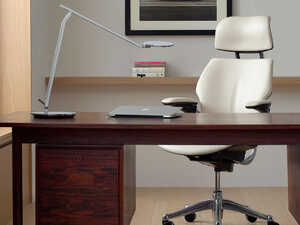
Set light levels based on tasks
Office lighting is often discussed in terms of brightness, but what matters is illuminance on the working surface. For many office environments, an appropriate target on desks sits around the 200-300 lux range, with the exact requirement depending on the type of work being carried out. Screen-heavy tasks can be comfortable at the lower end of that range, while paper-based tasks, detailed reading, and precision work typically require higher levels.
The problem in many office upgrades is that older fluorescent panels are replaced one-for-one with modern LED panels that produce higher output and different distribution.
That can lead to over-lighting, which increases reflected glare off white paper and desk surfaces and can feel uncomfortable over a full working day. A redesign that measures actual desk lux levels avoids that outcome and often reduces the number of fittings required, which can lower both project cost and ongoing energy use.
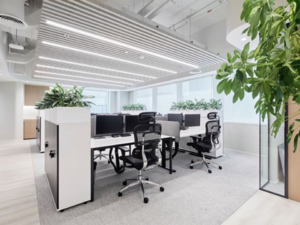
Control glare so screens remain comfortable
Glare is one of the most common causes of office lighting complaints, particularly in open-plan spaces with lots of monitors. Low-glare fixtures are designed to reduce the harsh reflected brightness that causes staff to squint or adjust screens constantly. In practical terms, this often means selecting panels or fittings with appropriate glare control, positioning them carefully relative to desk layouts, and avoiding strong reflections on screens and glossy surfaces.
Glare control also connects to uniformity. Offices feel calmer when light levels are consistent across the space. Bright patches and dark corners create visual strain and can lead to overcompensation, where a space is made brighter than it needs to be simply to hide poor distribution.
Cheaper LED lights, however, use less effective lenses with Insufficient filtering. The inadequate defusing causes reflections on the PC screens and also eye strain and discomfort. The latest filters used by LEDlights4you defuse and dissipate light, creating a flat light with better reflected light, similar to a photographer's studio.
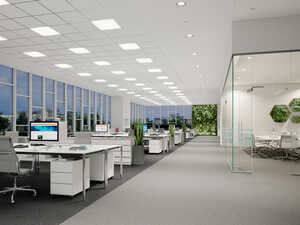
Choose flicker-free performance as a baseline
Lighting is often the biggest constant load for a business operation, sometimes as much as 70% of the energy bill. Good planning of new LED lighting and smart sensor lights can make very significant savings on your bottom line. Even heavy engineering industries can reap a significant reduction in energy use.
There are also savings to be made on maintenance costs. Older systems fail frequently, degrade in output as they age, and require ongoing labour to keep light levels acceptable. A well-specified LED system with long-life components reduces disruption from failures, cuts the time spent sourcing replacements, and supports more predictable running costs.
There is also a workplace benefit that often gets missed in financial discussions. Consistent lighting reduces shadowing, improves visibility, and can make workspaces feel cleaner and safer. Efficient retail lighting also improves presentation. These improvements are easier to achieve when the system is designed and commissioned properly.

Pick a colour temperature for the way the office is used
Colour temperature is often misunderstood due to some retailers preferring to use the terms cool or warm. Whilst these terms are simple to understand, the colour temperature is actually measured in Kelvin. This is a far more precise measurement, with 2,700 - 5000 meaning warm and 5000 - 6500 a cool white.
The key is consistency and purpose. When an office uses different colour temperatures in adjacent spaces without planning, it can feel disjointed and visually tiring. A clear approach to colour temperature across the workplace helps the lighting feel intentional and professional.
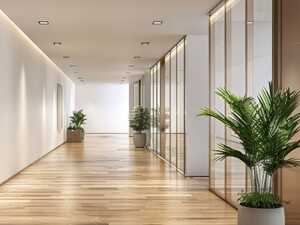
Use even distribution instead of excessive output
Uniform distribution is an often-overlooked feature in office lighting systems. Spaces can feel uncomfortable when some desks sit directly under bright fittings, while others sit in shadow. Good design considers fixture placement, spacing, ceiling height, and the reflective qualities of surfaces in the room.
LED panels and well-specified recessed downlights can provide clean distribution when they are selected and positioned to suit the room. The goal is a space where staff do not feel the need to move lamps around, tilt screens, or change seats to find a comfortable spot to work.
Add smart controls where they make sense
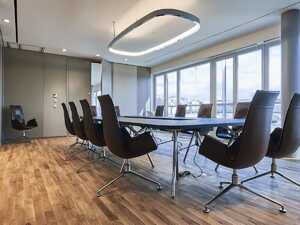
Offices are full of areas that do not need constant lighting. Meeting rooms sit empty for long stretches. Corridors and stairwells often run continuously; kitchens, print rooms, toilets and storage areas all have intermittent use.
Occupancy control solves that problem as LEDs reach full brightness instantly. Where offices have strong natural light, daylight response can also reduce energy use by dimming or switching off fittings when sunlight already provides enough illumination. This is particularly effective in perimeter zones near windows and in spaces with skylights.
Controls should be designed to match how staff use the space. Settings such as time delays and sensitivity can be tuned so lights respond reliably without nuisance switching, keeping the workplace comfortable while still reducing wasted run time.
Turn an office lighting project into a clear next step
Office lighting works best when it is designed around real working conditions. That means measuring what is happening on desks and in corridors, selecting fittings that control glare and provide stable output, and commissioning controls that reduce waste.
If you want an office that feels bright, comfortable, and consistent, start with a survey and a layout plan that targets the right lux levels across the workspace. It’s that kind of approach that gives you a specification you can trust, a clearer project cost, and a workplace that staff notice for the right reasons.
Posted on February 9th 2026


 Updating page...