
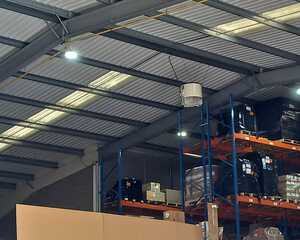
Lighting failures rarely arrive at a convenient time. Often, in fact, they will materialise in the winter months when daylight is short, sites are busy, but safety expectations remain high.
The right response will depend on what is failing, why it is failing, and what the failure is costing you in the background.
Start with safety and operational risk
If lights are failing in circulation routes, stairwells, loading areas, production lines or workshops, treat it as a safety issue first and a maintenance issue second.
Poor lighting increases the risk of trips, collisions, mistakes and near misses. If any fittings show signs of overheating, damage, loose connections, or erratic behaviour, isolate the area and involve a qualified electrician. LEDlights4you positions health and safety compliance as a core part of installation and electrical work, including NICEIC standards, where changes to circuitry are needed.
Recognise the common warning signs
Different technologies fail in different ways. Fluorescent lighting often flickers, depletes in light output, or becomes uneven in colour as tubes and control gear age. Metal halide fittings can dim and shift colour, and they can become unreliable as components wear.
LED systems, meanwhile, can fail because of driver problems, heat stress, or poor component quality. You may also see visual clues, such as discolouration on panels, or persistent sensor problems where lights stay on too long or fail to activate when the area is occupied. These symptoms help you decide whether you are dealing with a small repair job or a system that has reached end of life.
Decide what “repair” really means on your site
A repair is worthwhile when it restores reliable performance without creating a cycle of repeated call-outs. If you have a limited number of failures, fittings are relatively new, and replacement parts are available, targeted repairs can be a sensible short-term solution. It also helps if access is easy and the work can be completed without disruption.
Repair becomes less attractive when failures are scattered across the building, when fittings are difficult to reach, or when the system is ageing and no longer consistent. In those cases, a repair programme often turns into ongoing reactive maintenance, with unpredictable downtime and escalating labour costs.
When an upgrade becomes the practical option
Upgrading makes sense when the underlying technology is inefficient or the site is experiencing repeated failures. If your lighting is older than five years, or still relies on fluorescent or metal halide fittings, you usually have a strong case for review because those systems tend to have higher energy consumption and more maintenance demands.
Indeed, some first-generation LED installs underperform and can create over-lighting or under-lighting issues when installed as a direct swap. A redesign based on LUX levels avoids those problems and improves comfort and safety at the same time.
Use a simple cost comparison based on your own data
The most useful decision process is grounded in your building, rather than generic averages. Look at three numbers: the energy cost of the existing lighting, the cost and frequency of maintenance, and the operational impact of failures. Then compare that with a properly specified LED design that meets your required light levels and uses controls to reduce wasted hours. LEDlights4you’s lighting survey approach includes taking an inventory of existing fittings, noting current energy usage and maintenance costs, and recording LUX levels to support a clear proposal.
Consider controls as part of maintenance
If your lighting is often left on in empty areas, smart controls can reduce wasted hours and extend the life of the system by limiting unnecessary runtime. LEDlights4you supplies microwave sensor-controlled lighting that can scan a wide area and respond to small movements, supporting reliable activation in corridors, stairwells and large operational spaces. In buildings with skylights or strong daylight, daylight harvesting can also reduce runtime further.
Plan the upgrade so the site keeps running
A good upgrade plan minimises disruption. LEDlights4you describes flexible installation approaches that can be scheduled around operations, including working out of hours where needed, and testing and commissioning on completion. For businesses, this matters as much as the product specification, because the smoothest projects are the ones that keep staff safe and operations stable throughout.
Use interim measures when you need breathing space
Sometimes you need a short-term plan while budgets are approved or while a wider refit is scheduled. In those cases, temporary lighting, task lighting in critical work zones, or scheduling certain activities closer to daylight hours can reduce risk. It is also sensible to review emergency lighting performance, because emergency systems are your safety net when failures occur.
Reduce future failures with better specification and documentation
Long-term reliability comes from choosing commercial-grade fittings with an appropriate lifespan and warranty, then pairing them with a design that matches the work being done in each area.
Elsewhere, risk assessments, method statements, fitting plans and test certification support safe delivery and easier future maintenance. LEDlights4you references structured documentation and commissioning as part of our process for compliant installations.If your site is dealing with repeated lighting issues, the quickest way to get clarity is a survey and a plan. You can contact LEDlights4you to discuss repairs, phased upgrades, or a full refit designed around your building or business’s needs.
Posted by Paul on December 18th 2025


 Updating page...