
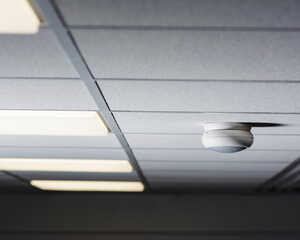
As well as the important business of saving energy, lighting control systems create smarter, more responsive environments. From warehouses to office corridors, the ability for lighting to respond automatically to occupancy and ambient conditions can dramatically reduce energy usage and improve safety.
The most common technologies used for occupancy sensing are microwave sensors and PIR (Passive Infrared) sensors. While both detect motion and trigger lights accordingly, the way they work – and where they work best – differ significantly.
Let’s take a look…
How PIR sensors work
PIR sensors are one of the most widely used forms of motion detection in commercial lighting. They work by detecting infrared radiation – essentially, the heat emitted by the human body. When someone moves within the sensor’s field of view, the change in infrared energy is detected, triggering the light to turn on.
PIR sensors, however, have their limitations. Because they rely on a direct line of sight to detect movement, they can miss activity behind objects, partitions, or shelving. They also tend to be most responsive when a person moves across the sensor, rather than directly towards it.
This makes PIR a better fit for smaller, enclosed areas where people walk through on predictable paths – such as toilets, stairwells, or meeting rooms.
How microwave sensors differ
Microwave sensors use radar technology to detect motion. They emit low-power microwave signals and measure the reflection that bounces back. Any movement – even a small one like someone shifting at a desk – disrupts this signal and triggers a response.
Unlike PIR sensors, microwave sensors can detect motion through materials like glass or thin partitions. They also offer 360° detection and much longer range, typically up to 10–15 metres depending on the fitting.
The result is faster response times, broader coverage, and more consistent performance – particularly in larger or more open areas. For this reason, microwave sensors are a preferred choice in environments like warehouses, distribution centres, corridors, and large offices where occupancy is irregular or where line-of-sight isn’t guaranteed.

The value of daylight harvesting
In many ways, microwave technology is the more complete smart control system.
Modern microwave sensor fittings can be programmed to dim after a period of inactivity, rather than switching off entirely. They can also work in conjunction with daylight sensors, adjusting output based on natural light levels. This process, known as daylight harvesting, ensures consistent light levels while reducing energy consumption.
For businesses with high ceilings, long operational hours, or irregular occupancy patterns, this kind of responsive control goes far beyond what PIR sensors can achieve.
Application matters more than price
While PIR sensors are often cheaper upfront, the long-term savings from microwave control systems can far outweigh the initial investment. If a PIR sensor fails to detect someone in time – especially in a warehouse or stairwell – lights may remain off or take too long to switch on, potentially compromising both safety and workflow.
Microwave sensors respond instantly and are far less prone to missed detections. This makes them especially effective in:
-
High-bay warehouse racking
-
Open-plan office zones
-
Car parks and underground storage
-
Hallways and corridors with inconsistent traffic
-
Cold storage or low-visibility zones
The ability to fine-tune sensitivity, hold time, and daylight thresholds also allows for a customised lighting experience, tailored to your facility’s needs.

Avoiding over-sensitivity
A common concern with microwave sensors is oversensitivity – detecting motion through walls or glass, leading to lights activating unnecessarily.
However, well-designed fittings from LEDLights4You include adjustable sensitivity settings. During installation, the sensors can be calibrated to your exact environment, ensuring they respond where needed – and not where they shouldn’t.
The level of control allows for precise coverage in even the most complex layouts.
Making the right choice for your building
Deciding between PIR and microwave sensors comes down to the nature of your space.
If you have small, enclosed rooms with predictable occupancy, PIR sensors may be sufficient and cost-effective. But for larger, dynamic spaces where performance, range, and reliability matter most, microwave sensors offer a significant upgrade in both user experience and energy savings.
At LEDLights4You, we don’t believe in one-size-fits-all. That’s why we offer free lighting surveys to assess your space, occupancy patterns, and energy goals. From there, we recommend the most suitable control system – helping you reduce costs, meet compliance, and create a better-lit environment.
Smarter lighting starts with smarter control
The difference between PIR and microwave sensors is a strategic consideration. One offers basic motion detection. The other offers intelligent lighting automation designed for the real-world complexity of modern buildings – and choosing the right sensor is the key to smarter energy use, better safety, and a more efficient facility.
Book your free lighting control assessment today and discover what smarter lighting could mean for your business.
Posted by Paul on December 23rd 2025


 Updating page...