
LEDLights4You recently completed a lighting upgrade in a private underground car park serving a residential development.
Built around 1985, the car park spans two levels and accommodates 63 vehicles. Four pedestrian staircases connect the parking areas with the houses and flats above, making the car park an important access route for residents throughout the day and night.
The existing fluorescent lighting system was outdated, inefficient and no longer providing the level of safety the site required. LEDLights4You designed and installed a new smart LED system that improved visibility, restored emergency lighting provision and reduced projected energy consumption by 88%.
The existing lighting system
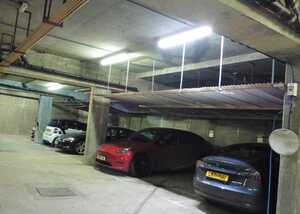
The car park had been fitted with ageing fluorescent fittings connected to a central relay and controlled by PIR sensors.
The system offered very limited control. The lights were either all on or all off, regardless of which part of the car park was in use. In practice, this meant the fluorescent fittings remained illuminated for much of the day.
With two levels of parking and lighting covering dozens of vehicle bays, this created significant unnecessary energy consumption. It also increased wear on fittings that were already approaching the end of their useful service life.
The existing controls provided a clear opportunity to reduce running costs by replacing the centralised arrangement with lighting that could respond independently to movement within each area.
An urgent emergency lighting problem
The most serious concern was the condition of the emergency lighting.
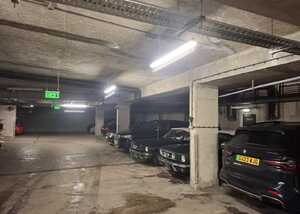
None of the existing emergency bulkheads were working. During a power failure, both levels of the car park would have been left in complete darkness.
Underground spaces receive little or no natural light, so the loss of the normal electrical supply creates a very different environment from an unlit outdoor area. Without functioning emergency fittings, residents would have been unable to see the route ahead, surrounding hazards or the entrances to the staircases.
The car park contained kerbs, drainage gullies, stairways and low sections of overhead ducting and pipework; features which increased the risk of trips, falls and collisions during an emergency.
The four pedestrian stairwells required particular attention. Residents leaving the relatively well-lit staircases would have entered a completely dark car park, with no time for their eyes to adjust. Restoring emergency lighting around these access points became an immediate priority.
Designing the new car park lighting
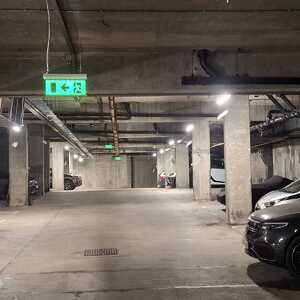
LEDLights4You proposed a system of individual LED battens fitted with microwave sensors.
Each fitting operates independently and activates when a resident or vehicle approaches. This means that only the relevant part of the car park is illuminated, rather than switching on every fitting across both levels.
The main lighting design required approximately one LED batten for every two to three parking bays. Microwave sensing was selected because it provides responsive movement detection across larger areas and can detect vehicles and pedestrians as they move through the car park.
The new arrangement provides useful illumination exactly where needed, while avoiding the prolonged operating hours associated with the previous central relay system.
A complete emergency lighting upgrade
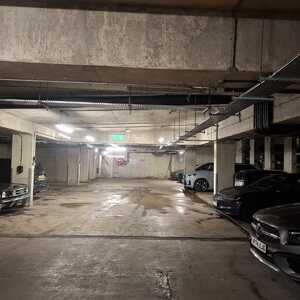
The emergency lighting system was redesigned using three different types of fitting, each selected for a specific area of the car park.
Maintained emergency bulkheads were installed on either side of the fire doors. Maintained fittings remain illuminated during normal operation and continue to operate from their battery supply if mains power is lost.
The old fluorescent emergency bulkheads along the car park driveways did not provide sufficient illumination, so they were replaced with twin-spot emergency fittings. They provided the stronger, more focused coverage needed across the vehicle routes and surrounding hazards.
Additional maintained hanging exit blade signs were also installed to make escape routes easier to locate. The combination of illuminated exit blades, maintained bulkheads and twin-spot fittings gives residents a clear visual route through the car park during a power failure.
The improved system removes the complete darkness previously experienced across the site and provides a far safer environment around the parking bays, stairways and escape routes.
Self-testing emergency lighting
Every emergency fitting installed as part of the project includes self-testing technology.
Self-testing emergency lights automatically carry out their scheduled functional and duration tests. The fittings display a warning when a battery, lamp or internal component requires attention.
This reduces the time required for manual testing and gives the site management team a clearer picture of the condition of the emergency lighting system.
It also lowers the risk of failed fittings remaining unnoticed between inspections, which had been a major issue with the previous installation.
The Results
The completed project has transformed the lighting across both levels of the residential car park.
Residents now benefit from responsive LED lighting as they drive or walk through the site. The four staircase entrances have clear ambient illumination, while the new emergency system provides visible escape routes and effective coverage across the vehicle areas.
The individual microwave controls have also delivered a substantial reduction in unnecessary operating hours.
Projected energy saving: 88%
Projected five-year saving: £44,226
Estimated return on investment: Approximately 12 months
The combination of lower energy consumption, improved visibility and self-testing emergency lighting provides a safer and more efficient long-term solution for the residential development.
88%
Energy Saving
£44,000
Projected 5-year saving
Upgrade your car park lighting
Older fluorescent lighting and ineffective controls can create high running costs, poor visibility and serious emergency lighting risks.
LEDLights4You can survey your car park, assess existing light levels and design a smart LED system around vehicle movements, pedestrian routes and emergency escape requirements.
Posted on July 23rd 2026


 Updating page...