
Lighting fundamentally shapes how employees experience their workplace, impacting everything from basic visibility and comfort to concentration, alertness, and overall atmosphere.
While energy savings are often the primary driver behind a commercial lighting upgrade, light quality is just as critical. Staff routinely spend long hours under artificial light, meaning a poorly designed system can easily cause fatigue, distraction, and physical discomfort.
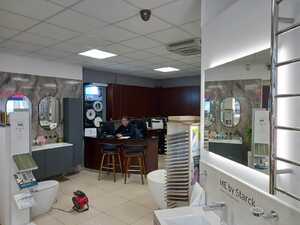
Why workplace lighting affects how people feel
Lighting within commercial, industrial, and office environments must fit the function of the space. A working office, for example, demands a completely different layout from a warehouse packing zone, showroom, workshop, or healthcare facility.
Implementing the correct LED system ensures appropriate brightness levels, minimal glare, accurate colour rendering, and uniform coverage. Professional planning allows staff to see clearly, work in comfort, and navigate the premises safely.

Visual comfort, glare and eye strain
Visual comfort is a critical element of a successful workspace. Legacy fluorescent fittings frequently suffer from uneven light distribution, visible ageing, colour shift, and intermittent flickering. Similarly, low-specification LED panels introduce their own issues when configured with low-grade drivers, harsh lenses, or inappropriate colour temperatures.
Glare also presents a persistent workplace challenge. Overly bright fittings placed in unsuitable positions, or panels utilising sub-standard diffusers, cause distracting reflections on desks, monitors, and polished surfaces. Accumulating over the course of a day, visual discomfort makes everyday work feel unnecessarily fatiguing.
It’s an issue particularly common with direct one-for-one LED retrofits, where older fluorescent boxes are replaced with high-output LED panels without any reconsideration of the room layout. The approach often floods the space with excessive reflected light, creating a harsh glare on white desk surfaces and paper documents.
Through a professional lighting survey that accurately records LUX levels, specialists can engineer a layout designed for specific workplace tasks – rather than blindly duplicating the original fitting count.
Flicker and fatigue in the workplace
While not visible to the naked eye, flicker can still contribute to eye fatigue, headaches and discomfort – issues particularly relevant in offices where staff spend much of the day looking between screens, paper and the surrounding room.
Modern, high-quality LED fittings use better drivers to provide a more stable light output, helping create a calmer visual environment in offices, classrooms, healthcare settings and other spaces where people spend long periods under artificial lighting. Choosing good-quality fittings at the start can prevent many of the comfort issues associated with cheaper LED panels.
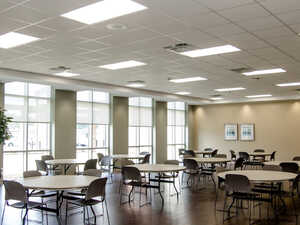
Choosing the right colour temperature
Colour temperature significantly influences the atmosphere of a workspace. Cooler lighting helps with high-focus areas like warehouses and production lines by enhancing alertness and visibility.
However, for most offices, classrooms, and staff break rooms, a softer 4000K neutral white offers a far more comfortable experience. While overly cool lighting can feel sterile in the wrong environment, excessively warm light lacks the crispness required for focused tasks, meaning a specific approach is vital for each room.
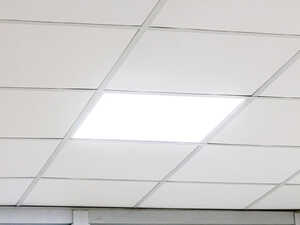
Lighting and the body’s daily rhythm
The connection between light and the body’s internal clock is another reason to think carefully about workplace lighting. Natural daylight changes throughout the day, and our bodies respond to those changes. Bright, well-distributed light can support alertness during working hours, while softer lighting may be more suitable for break rooms or areas where people need to relax between tasks.
Some modern LED systems can also include dimming or tunable white controls, allowing lighting to be adapted for different activities or times of day. In larger workplaces, this can be particularly useful where one building contains focused work areas, meeting rooms, rest areas, circulation spaces and customer-facing areas.
Smarter controls for better working environments
In practical terms, most businesses do not need a complicated lighting system to improve the working environment. Effective results often start with a proper survey, high-quality LED fittings, a suitable colour temperature, low-glare lenses, and a layout based on LUX readings.
In areas with variable use, microwave sensors can also improve both efficiency and comfort. Corridors, toilets, storage areas, stairwells, and low-occupancy zones can be lit automatically when needed, reducing the waste from lights left on all day.
Designing lighting around people
A well-designed LED upgrade should consider both the energy performance of the building and the people using it.
LEDLights4You combines lighting surveys, consultancy, product specification and professional installation to help businesses choose fittings that are efficient, reliable and suitable for the space.
Posted on June 1st 2026


 Updating page...