
Outdoor lighting has a direct impact on how safe, secure and usable a business premises feels after dark.
Put simply: car parks, walkways, loading bays, entrances, service yards, and building exteriors all need reliable illumination so that staff, visitors, delivery drivers, and security teams can move around with confidence.
Conversely, poorly lit areas create trip risks, make CCTV less effective and can leave parts of a site feeling neglected or exposed.
For many businesses, outdoor lighting is only reviewed when something fails: a floodlight suddenly stops working, a dark patch appears in a car park, or an old fitting becomes unreliable during winter.
A more considered, long-sighted approach can improve visibility, reduce maintenance and keep energy use under control.
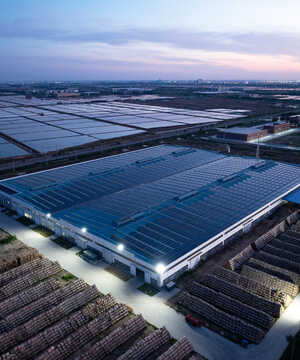
Why older outdoor lighting can fall short
Many commercial and industrial premises still rely on older outdoor fittings, including halogen, metal halide or sodium lamps.
Such technologies can be expensive to run, slow to reach full brightness and difficult to maintain – particularly when fittings are mounted high on walls, columns or warehouse exteriors.
Some old lamps, meanwhile, gradually degrade, so the site becomes dimmer over time before anyone realises how much visibility has been lost.
Warm-up time is a common issue with older HID lighting. In areas such as loading bays, side entrances or staff car parks, lights need to turn on immediately when switched on or activated by movement.
LED lighting, by contrast, reaches full brightness straight away, providing instant visibility when needed – especially useful for motion-activated security lighting, where delayed brightness can reduce the fitting's value.
Maintenance cost is another important consideration.
Outdoor fittings are often installed in hard-to-reach places, which makes every lamp change more disruptive and, predictably, more expensive.
A failed floodlight may require access equipment, careful scheduling and downtime in the area below. Good quality LED fittings offer long service life and lower maintenance requirements, making them well-suited to perimeter lighting, high-level wall lighting and external working areas.
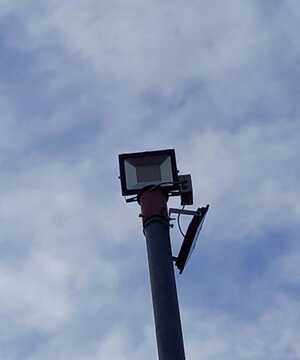
Efficient lighting for large outdoor areas
Outdoor security lighting needs to effectively cover large spaces.
This makes efficacy, measured in lumens per watt, particularly important. A more efficient LED fitting delivers high light output while using less electricity, helping businesses illuminate wider areas without unnecessarily increasing running costs.
This is valuable in car parks, distribution yards, industrial estates, retail parks and warehouse loading areas where lights may be used for long periods during autumn and winter.
A well-planned LED upgrade can often improve visibility while reducing the amount of energy used by old fittings. The best results come from choosing fittings that suit the site, mounting height, and area being lit.
Floodlights are often used for open external areas where broad coverage is required. Bulkheads can work well around entrances, walkways, bin stores, service corridors and external doors where practical, lower-level lighting is needed.
On larger sites, both may be used together to create layered coverage, with stronger lighting in open areas and more controlled illumination near pedestrian routes.
Choosing the right outdoor fittings
Outdoor lighting must be robust enough to withstand ever-changing weather conditions.
For exposed commercial environments, IP-rated fittings are essential. IP65- and IP66-rated products are commonly used for outdoor lighting because they are designed to resist dust and water ingress – helping protect the internal components and support reliable performance in rain, wind and fluctuating temperatures. For this reason, LEDLights4You uses a unique balanced valve technology to prevent early failures in food lights. Some of our existing installations are ten years old and still going strong.
The correct rating will depend on the level of exposure. A fitting under a canopy may have different requirements from one mounted on an external wall facing open weather. Areas near loading bays, vehicle movement, pressure washing, or coastal conditions may need additional consideration. A professional lighting survey can identify which fittings are suitable for each part of the site.
Build quality also plays a significant role. Cheaper outdoor lights may appear cost-effective, but early failure can quickly erase any initial savings made.
For businesses, the cost of replacing a failed external fitting is rarely limited to the product itself. Labour, access equipment, disruption and safety arrangements can all add to the overall cost. Long-life, commercial-grade LEDs provide a stronger long-term solution for premises that rely on dependable lighting every night.
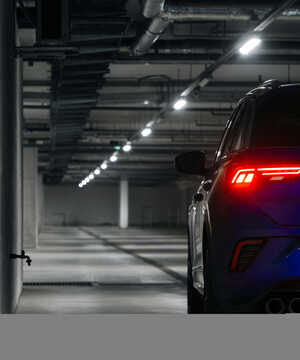
Sensors, photocells and smarter control
Outdoor lighting does not always need to run at full output throughout the night. Sensors and photocells give businesses more control over when lights operate.
A photocell can automatically switch lights on when daylight falls and off when natural light returns. Motion sensors can activate lights when movement is detected, making them useful for entrances, side paths, yards and lower-traffic areas.
Importantly, it’s an approach that helps reduce wasted energy. Instead of relying on staff to remember switches, lighting responds to the conditions around the building.
A car park can remain safely lit when needed, while secondary areas can operate only when movement occurs. In some locations, a combination of photocell and sensor control may be the most effective option, allowing fittings to remain off during the day and activate at night when activity is detected.
Sensor-controlled lighting can also help improve security. Sudden illumination can draw attention to movement around a building, helping staff, neighbours or security cameras identify activity more clearly. Lighting design should still be carefully planned, as overly sensitive or poorly positioned sensors can lead to nuisance activation.
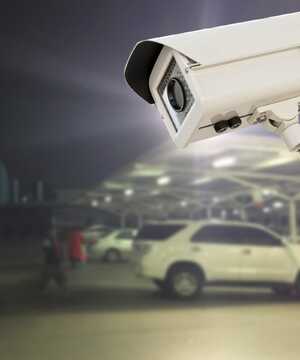
Balancing brightness, glare and CCTV visibility
Security lighting needs to provide useful visibility without creating glare. Excessive brightness can cause discomfort, spill into neighbouring properties and reduce the effectiveness of CCTV if cameras are dazzled by direct light.
A bright fitting in the wrong position can create harsh shadows, leaving some areas over-lit and others still difficult to see.
Positioning and shielding, then, are key.
Lights should be aimed to illuminate the ground, entrances, vehicles and pedestrian routes rather than shining directly into cameras, windows or the eyes of people moving through the site.
Even coverage is usually more useful than extreme brightness in one place. For many security areas, guidance often points towards around 5 to 10 lux, although the right level will depend on the site, risk and purpose of the area.
CCTV should always be reviewed alongside lighting systems. Cameras need consistent illumination to capture clear images, especially around faces, number plates, entrances and boundary lines.
If lights are too close to the camera, angled incorrectly or positioned behind the subject, image quality can suffer. An outdoor lighting upgrade should consider both human visibility and camera performance.
Reviewing your premises after dark
One of the simplest ways to assess outdoor lighting is to walk the site after dark. This helps reveal weak spots that may be missed during the day. Car park corners, loading bay edges, bin stores, external stairways, pathways, side doors, and boundary areas should all be reviewed from the perspectives of staff, visitors, and delivery drivers.
During the audit, it is worth noting failed fittings, dark patches, glare, shadows, poor CCTV visibility and areas where people may feel less secure.
The condition of old fittings should also be checked, especially if lamps have become dim, discoloured or unreliable. If outdoor lights are difficult to access, planning replacements before they fail can avoid urgent callouts and unexpected disruption.
A safer and more efficient site after dark
LED outdoor and security lighting provides businesses with a reliable way to improve safety, visibility, and site protection. With instant full-brightness, high efficiency, long service life, and smart control options, LED floodlights and LED bulkheads are well-suited to the lighting needs of commercial premises.
The best results come from planning the upgrade around the site itself. The right IP-rated fittings, sensible positioning, effective sensor control and careful glare management can create a safer environment without excessive energy use.
LEDLights4You can assess your existing outdoor lighting, identify weak spots and recommend efficient LED solutions for car parks, walkways, loading bays and external building areas.
Posted on June 30th 2026


 Updating page...