
For many businesses, reducing carbon emissions starts with an evaluation of how energy is used daily.
Lighting is often one of the largest sources of electricity consumption in commercial and industrial buildings, especially in warehouses, factories, offices, schools, healthcare settings, and retail spaces where lights may be on for long hours every day.
It’s the reason why lighting upgrades are often among the most practical ways to reduce both energy use and the carbon footprint. A well-designed LED system uses far less electricity than older fluorescent, halogen, and metal-halide fittings, while also improving the quality and consistency of light across the workplace. For businesses under pressure to reduce operating costs and operate more sustainably, lighting is a sensible place to start.

How LED lighting cuts energy use and carbon emissions
The key environmental benefit of LED lighting comes from efficiency.
Older lighting systems waste a large proportion of the electricity they consume. Fluorescent and metal-halide fittings also deteriorate over time, leading to declining light quality while energy use remains high. That leaves many buildings paying for poor performance.
High-quality commercial LED fittings can significantly reduce electricity use compared with older technologies, and the savings are even more valuable in buildings that operate for extended hours. In a warehouse, for instance, lighting may run across early starts, late dispatches and seasonal peaks. In a school or healthcare setting, there may be long daily operating periods across classrooms, corridors, waiting areas and offices. The more the lights are used, the greater the opportunity to reduce waste.
There is also the issue of lighting quality. Sustainable lighting is about delivering the right light levels for the right task, improving visibility, and avoiding the poor performance that leads to over-lighting, glare, shadows or frequent maintenance.
A lighting upgrade should reduce energy use while providing staff with a safer, clearer, and more comfortable work environment.
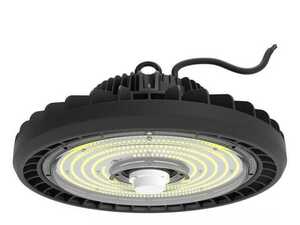
Smart controls help you save even more
LEDs are already highly efficient, but controls are where extra savings can really add up.
Microwave sensor lighting is especially useful in commercial buildings where some areas are occupied all day, while others are used only when needed.
In a warehouse, staff may be working in one aisle while another sits empty. In a school or office, corridors, toilets, staircases and communal areas do not need full lighting output all day long. In medical or industrial settings, some spaces have changing occupancy patterns throughout the day and evening.
This is where sensor-controlled lighting becomes a very effective sustainability tool.
Microwave sensors can detect movement over a wide area and quickly switch lights on when required. They can also be set to respond to daylight, so artificial lighting does not continue burning when natural light is already sufficient. That means less wasted electricity and a lower carbon footprint without compromising safety or usability.
Longer-life lighting reduces waste and maintenance
Sustainability also covers durability. If a fitting fails after only a few years, the environmental benefit is reduced by the need to manufacture, transport and replace it again.
In many workplaces, maintenance itself has a cost beyond parts and labour. Replacing fittings in warehouses, production areas, workshops, sports halls or external spaces often involves access equipment, disruption, planning and lost time. Long-life LED fittings reduce that burden considerably.
Quality LEDs can operate for tens of thousands of hours, and some of the specialist commercial products supplied by LEDLights4You are designed for long service life in demanding environments.
So, fewer replacement cycles, less material waste and a more dependable system overall. For businesses seeking to improve environmental performance in practical ways, reducing waste should be a key component of the strategy.
A practical step towards environmental targets
Most businesses are now under greater pressure to show progress on sustainability, for some, that comes through formal environmental targets or reporting. For others, it is driven by customer expectations, internal cost control or a wider commitment to reducing waste and energy use.
Sustainable lighting is one of the most straightforward upgrades a business can make to cut waste and improve efficiency. With the right survey, the right design and the right products, the savings can be significant and long-lasting.
Posted on April 30th 2026


 Updating page...