
Large industrial buildings place exceptional demands on a typical lighting setup. High roofs, long aisles, shifting stock layouts and extended operating hours all influence how well a system might perform.
In many warehouses, lighting runs for most of the day and often through night shifts, so design decisions have a direct effect on safety, productivity and operating cost.
An effective lighting scheme starts with a full assessment of the layout, activity zones, and existing fittings, then moves into a practical design that balances light quality, control, and durability.

Start with task zones and required light levels
The first step is to map the building by activity, as general storage aisles, loading areas, dispatch lanes, packing benches and inspection points all have different visual requirements.
In most modern warehouses, operators aim for an average reading around 150 lux in general movement and storage areas, with higher levels in task-focused zones such as picking verification, packing, and inspection, where 300 - 500 lux is commonly used as a working benchmark.
The difference is important as visibility standards in high-concentration tasks directly affect accuracy, speed and incident risk.
Designing for task zones also avoids a common mistake: replacing fittings one-for-one without redesign. Modern LED output and optics differ significantly from older fluorescent or metal halide systems. A measured, well-thought-out redesign provides cleaner coverage, fewer shadowed areas, and better consistency across floor level and vertical rack faces.
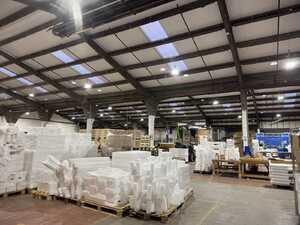
Choose fittings that match ceiling height and building use
Typically, in warehouses and factories with higher rooflines, dedicated high bay LEDsare the advised starting point as they are built to project useful light to working level without excessive glare.
In lower zones, mezzanines, service corridors and support spaces, commercial battens often provide better spread and easier maintenance access. The decision should be based on mounting height, racking profile, aisle width and the amount of vertical illumination needed for picking and scanning.
Optics are equally important. Wide-beam distributions can improve uniformity in open areas, while tighter control can suit defined aisles and focused work zones. This is where a proper lighting plan earns its value. Indeed, beam selection and spacing affect both light quality and energy use, and a well-planned light installation can improve usable light while reducing wasted output.

Remove dark spots to improve safety and flow
For warehouse stakeholders, uneven lighting is a chief concern as it introduces unnecessary operational risk. Dark aisles, poor transition points near shutters, and low visibility around loading doors can increase errors and near misses, especially where forklifts and pedestrians share space.
A warehouse lighting scheme should be checked at floor level and at rack face height so key routes and working positions remain consistently visible.
Alongside safety concerns, uniformity is critical for employee comfort. Frequent transitions from bright to dim zones can strain visual adaptation during shifts, slowing movement and increasing fatigue. Good design keeps light consistent across routes, intersections and handover areas. In fast-moving operations, that consistency helps teams work with confidence and reduces disruption in peak periods.
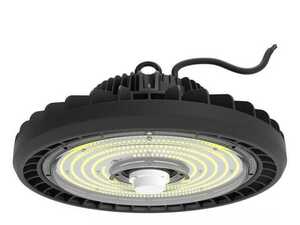
Use smart controls to cut waste without reducing visibility
Smart controls are one of the strongest levers for energy reduction in industrial spaces. Microwave sensor smart LED lighting is particularly effective in warehouses as it’s able to monitor occupancy across large areas and activate lights quickly when movement is detected.
In practice, this allows aisles and work areas to be illuminated when needed and to reduce output when vacant.
Daylight harvesting adds another layer of savings in buildings with rooflights or skylights. Where natural light is sufficient, controlled LED systems can dim or switch off automatically, reducing run hours and unnecessary load. For operators managing rising electricity costs, a control strategy helps contain spend while maintaining safe working conditions during occupied periods.
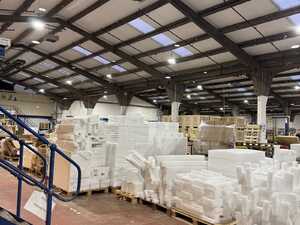
Specify for durability, maintenance access and environment
Industrial lighting needs to withstand dust, vibration, temperature shifts and long operating cycles. IP ratings should be selected for the environment, with higher ingress protection in dirtier or damp areas. Temperature tolerance is also a consideration in unheated units or spaces with heat gain from process equipment. Product lifespan and warranty terms should be reviewed alongside build quality, so maintenance planning is realistic.
Long-life fittings can reduce access equipment hire, callout costs and disruption to operations – especially valuable in high-ceiling environments where replacing failed units is time-consuming and expensive. A durable specification backed by reliable components helps continuity and lowers lifetime cost.
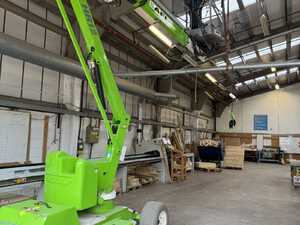
Plan installation around operations and compliance
Warehouse upgrades should be phased around trading patterns, dispatch windows and shift structures. A skilled light installation team can sequence work by zone and complete high-impact areas during quieter periods, reducing operational interference. Electrical works must be carried out to recognised standards, with clear testing, certification and handover documentation.
For many businesses, the strongest outcomes come from a combined package that includes surveying, design, installation, control setup, and post-installation checks. It’s an approach that keeps accountability clear and gives facilities teams a system that is ready to run from day one, with controls set to match how the building operates.
Build a system that supports long-term performance
Warehouse lighting influences safety metrics, picking quality, workflow speed and energy consumption every single day.
A modern LED system designed around task zones, smart controls and durable hardware gives measurable operational advantages over ad hoc replacement programmes. It also creates a better environment for staff, which supports consistent output across long shifts.
If your site still relies on ageing fittings, inconsistent coverage or manual switching, a survey-led redesign is the first practical step. The right solution will improve visibility, reduce waste and give your team a system that performs reliably over the long term.
Posted on February 9th 2026


 Updating page...